
The Layman's Guide to Borderline Personality Disorder

In this post, we will focus on a specific mental health disorder called Borderline Personality Disorder or BPD for short. While researching various disorders, I came across one that gave me that "aha" moment. You all know the moment I'm talking about. The one where you read or see something and just know that it was meant for you or in this case, describes you to a tee. Ironically, someone once said to me that they didn't want to read anything (about a mental illness) because then they would have it (or catch it) too. If only it worked that way, especially in reverse. If we ignore them, they will just go away, right? To be so lucky.

If you've read my Harsh Truths about Mental Illness, Life, Love, and the Pursuit of Happiness post, you know that I was just recently diagnosed with Borderline Personality Disorder although I suspect I have had it for the better part of 25 years now, maybe more. Or what I think is BPD might just be the PTSD (love me some acronyms) talking. Either way, let's explore what constitutes Borderline Personality Disorder. According to the Mayo Clinic, BPD is a 'mental health condition that affects the way people feel about themselves and others, making it hard to function in everyday life. It includes a pattern of unstable, intense relationships, as well as impulsiveness and an unhealthy way of seeing themselves. Impulsiveness involves having extreme emotions and acting or doing things without thinking about them first.'
Now that we have a general understanding of what BPD is, let's explore the diagnostic criteria / common traits for determining if someone has BPD, possible causes of BPD, typical treatments, and what having BPD means for me.
Diagnostic Criteria / Common Traits of BPD
According to the DSM-5, to receive a diagnosis of borderline personality disorder, an individual needs to have exhibited five or more of the following criteria/traits:
Fear of abandonment - An individual will make frantic efforts to avoid being abandoned and real or perceived abandonment will have a severe impact on their self-image, cognition and behavior. They feel that there is something innately wrong or bad about themselves that leads to the "abandonment."
Unstable, intense relationships - there will be a pattern of unstable and often times intense relationships. These can be from a caregiver, romantic partner or even a friend. Individuals with BPD may desire to spend unhealthy amounts of time with one person, overshare early in a relationship and quickly switch back and forth between idealizing and disparaging someone.
Unstable self-image or sense of self - an unstable self-image is typically based on feelings of being bad or evil or even that they don't exist or matter at all.
Impulsive and/or dangerous behavior - individuals with BPD will usually display impulsive or dangerous behavior in at least two, if not more areas such as gambling, spending money irresponsibly, binge eating, substance abuse, drinking, unsafe sex or reckless driving.
Repeated self-harm or suicidal behavior - there may be recurrent suicidal behavior, threats, gestures or self-mutilating behavior present. It is very common for a person to perform self-mutilating acts such as cutting or burning, especially during a dissociative episode.
Rapid mood changes - just as it states, someone with BPD will experience rapid changes in mood, such as irritability, anxiety, restlessness, despair and so on. These mood swings may only last a few hours or so much as a few days.
Persistent feelings of emptiness - individuals may experience chronic feelings of emptiness or loneliness (even when they are not alone) and become easily bored. During this boredom, they may seek out things that provide excitement to avoid their feelings of emptiness.
Anger management issues - everyone experiences levels of anger, however, the person suffering from BPD may experience frequent intense and inappropriate levels of anger and having difficulty reigning their anger in. This can take the form of extreme sarcasm, bitterness and verbal abuse or outbursts.
Temporary paranoid thoughts or dissociation - individuals may experience transient paranoid ideation or dissociative symptoms. Dissociative symptoms include memory loss, feeling disconnected from one's surroundings, or having distorted perceptions of reality.
Some individuals may experience only five of these symptoms, some may experience all ten and others may experience any number of them. An individual can have BPD tendencies (experiencing some of the symptoms above at some point in their life, but not five or more for an extended period of time. Typically individuals diagnosed with BPD begin showing these traits in late childhood to early adulthood.
There are four main subtypes of BPD. Although they are not specifically listed in the DSM, the four types that have been widely accepted are discouraged (or quiet BPD), impulsive, petulant and self-destructive. We will save the details of those subtypes for a later post but just know that individuals with BPD can suffer from one or more simultaneously or at different stages in their life or none of those specific subtypes at all.
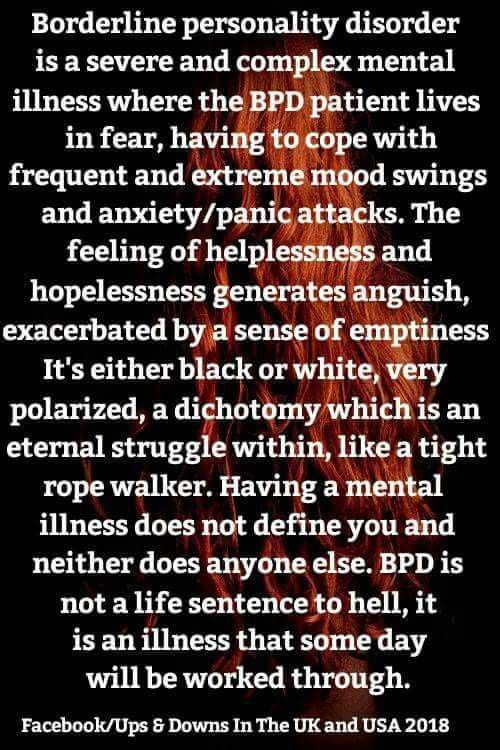
Causes of BPD and Typical Treatment
BPD is thought to be the result of one or more of three main factors which include:
Childhood abuse and trauma
Genetics
Brain changes
Speaking from personal experience, I am certain that mine has stemmed from the years of childhood abuse I suffered. Statistically speaking, up to 70% of people with BPD have experienced sexual, emotional, or physical abuse as a child. Additionally, studies show that if you have a family history of the disorder, you are at a higher risk of developing BPD but that does not mean it's a certainty. The last cause is just as it reads, brain changes. The area of the brain that controls impulses and regulates emotions, functions differently in BPD sufferers than everyone else.
Be kind, for everyone you meet is fighting a hard battle. - Plato
Now that we've addressed the potential causes of BPD, let's discuss the typical treatment associated with this disorder. According to the National Alliance on Mental Illness, Psychotherapy, also known as talk therapy, is the main therapy used for treating individuals suffering from BPD as it focuses on addressing emotional dysregulation.
There are three main types of psychotherapy that have been show to successful in treating BPD. They are as follows:
Dialectical behavioral therapy (DBT) - is designed to teach coping skills that combat counterproductive urges, regulate emotions and improve relationships. This form of therapy encourages individuals in practicing mindfulness techniques.
Cognitive behavioral therapy (CBT) - this type of therapy addresses negative thinking as well as behaviors associated with BPD in an effort to help individuals recognize their negative thoughts and learn more effective ways of coping.
Mentalization-based therapy (MBT) - MBT focuses on helping individuals become conscious of their internal state. It also teaches people how to develop empathy for other people's experiences.
Medication can also be used to treat BPD, however, there is no specific medication designed to treat the disorder. Rather, medications are used to treat various symptoms of the disorder such as anxiety, depression and emotional regulation.
What Having BPD Means for Me
Where do I begin to answer this statement? Of the nine diagnostic criteria listed above, I have experienced all of them for extended periods of time throughout most of my teen years and all of my adult life. All at one time? Not usually, but the majority? Yes. Some worse than others to be certain.
As I mentioned, there are four subtypes of BPD. And while I'll save the deep dive of that for a later post, I think it's safe to say I have a mixture of two of them on any given day. That still doesn't answer the question, does it? What does having BPD mean for me?
Although I have suffered from BPD for the better part of 30 years, I would like to think that I managed it fairly well until the last several years. But what changed in the last several years that could have such a severe impact on my mental health? There were two very distinct life events that profoundly impacted who I was, who I currently am and who I will become. The first was my mother's injury that subsequently led to her passing and the second was having to deal with (or become responsible for) the well-being of my childhood abuser. Enough to throw off even the strongest of people.
Where have I been struggling the most with the traits listed above? The first would have to be emotional regulation (rapid mood changes). I know on any given day my emotions can be pretty volatile, ranging from happy to sad to extremely happy to anger, bitter, doubt, and so on. Going from one extreme to the next.
The second one is probably anger management issues. I tend to go from zero to a hundred in a blink of an eye. I do recognize this about myself; actually I recognize a lot of the negative things about myself (see number three above) but it's as if my brain and my mouth are not in sync, and my brain has not caught up to the shit that has come out of my mouth until it's too late. Unfortunately, this trait tends to severely impact the relationships in my life. The anger never lasts. It's kind of like the movie Gone in Sixty Seconds and although it doesn't stick around for long, the damage it causes lasts much, much longer.
Of course, those two traits alone exacerbate the remaining traits on the list. It is one of the reasons someone (myself especially) with BPD will stay so busy. Always needing to be on the go or doing something to occupy my mind lest it be still, giving me more time to think of all the ways I have screwed up, can screw up or will screw up. Our brains are hardwired differently. If we could tell the ones we love just one thing, more than anything, we would want them to know that nothing we do is done maliciously, with the intent to hurt you. We more times than not, don't even realize we have acted, said or done something so horrendous until after it has happened. We don't want to be "messed up". We don't like feeling like a failure. We despise the way we are and we are trying as hard as we possibly can to relearn a better way to be as quickly as we can.
Ironically, the image below talks about the cooler side of BPD. They were definitely looking for the good in a sea of bad....I'd like to think these are the brighter side of having BPD.

I know I have said this many times in my previous posts, but, life is hard. And mine is messier than most yet I choose to fight every single day to be in a better place than I was the day before. Life is all about the choices we make. Some days I make good choices, other days I make great choices and some days, I make really really shitty choices. It's when I reflect on the last of those choices that I find the most potential for growth. If we did everything right all the time, what would we ever learn? I have learned more from my struggles and the mistakes I've made than any great choice I made (the first time around).
I don't say these things because I feel I am better than anyone else or because I want recognition for working hard but rather to let others who suffer know that you aren't alone in what you are going through. Most people don't care about your struggles unless they are paid to do so or they are your family (and that can be debatable) but I want you to know I care. I know how hard it is to keep going when all you want to do is give up and I am 100% rooting for you to succeed but when you have doubts, and you will have doubts, remember that one thing that keeps you going. It could be a mantra, bible verse, favorite song, or goal you set for yourself. Whatever it is, hold on to it tight during those hard times.


Comments